
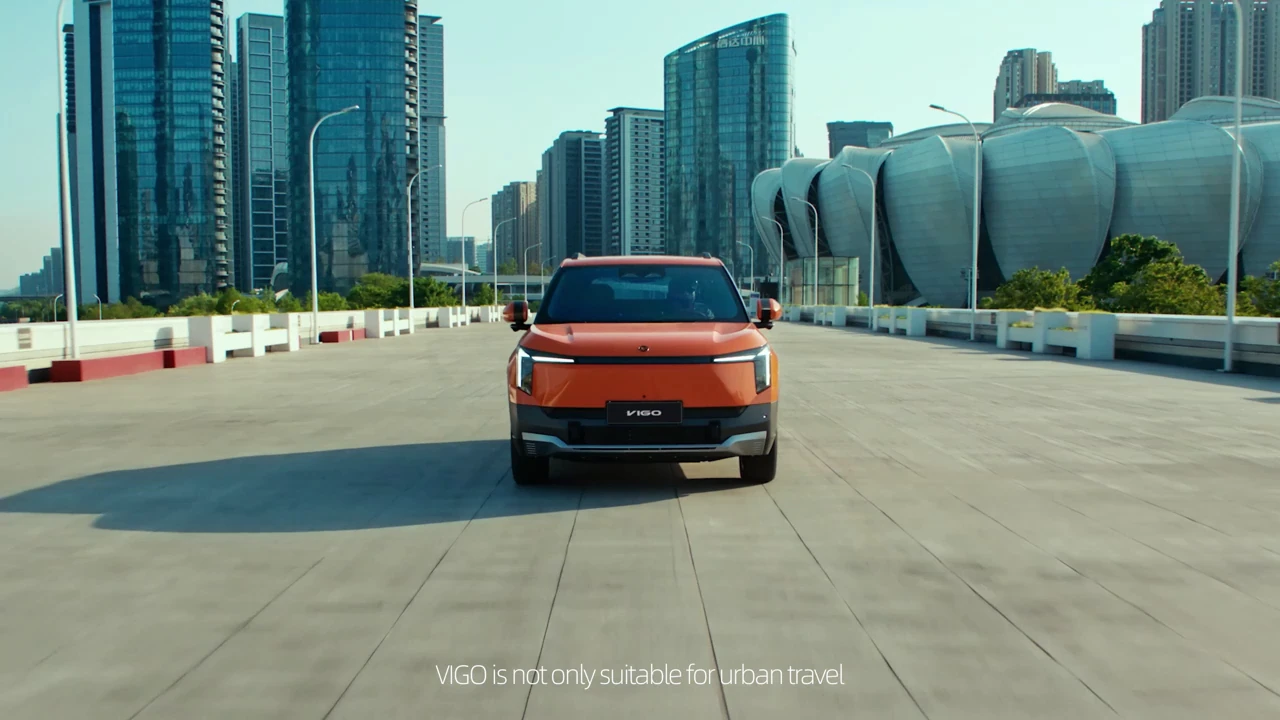
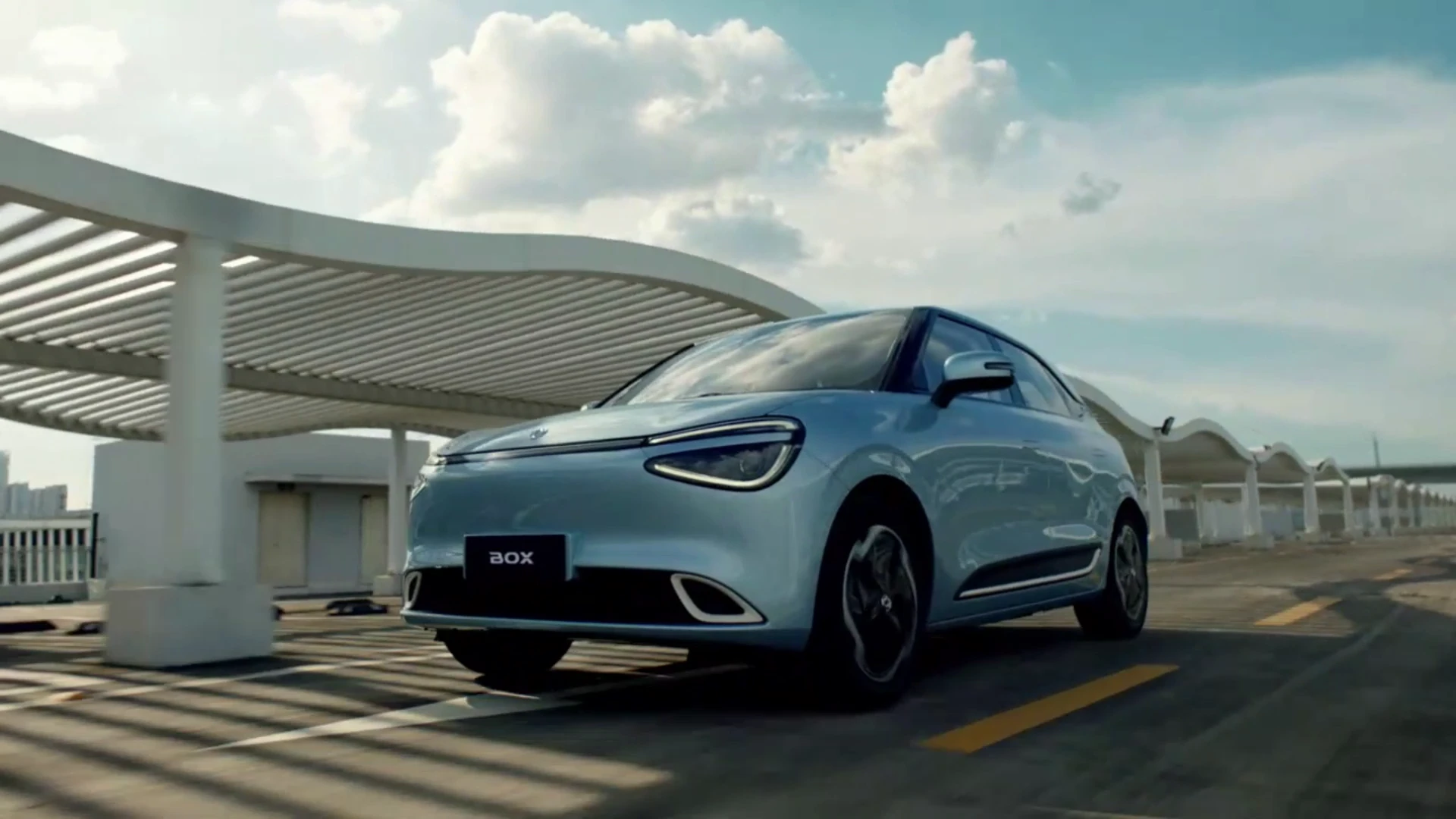
Open up.
Two-section tailgate
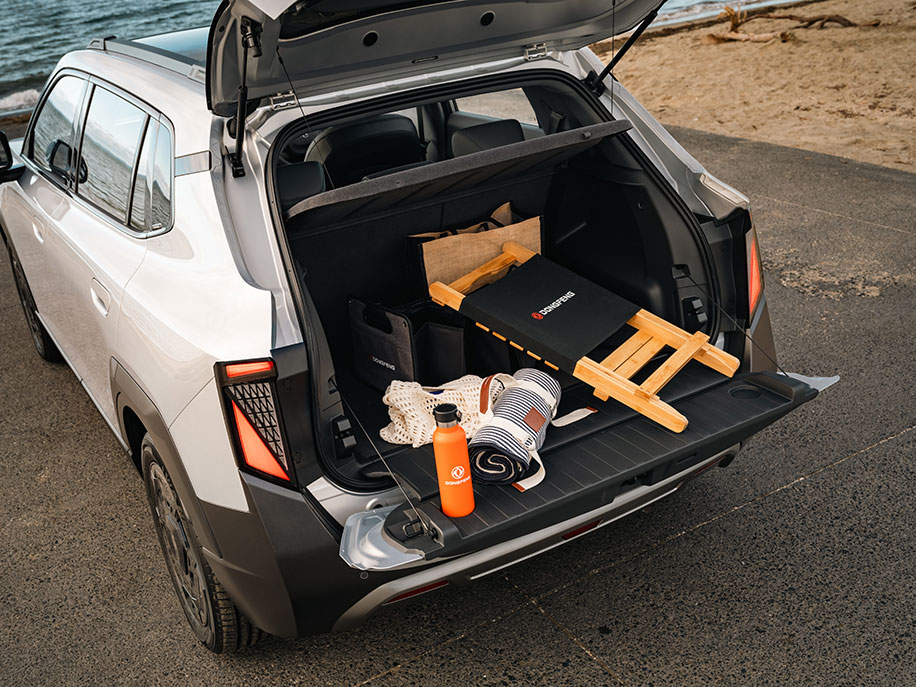
Open the upper section independently; use the lower section as a loading platform. Confirm its load rating before sitting on it.
Brochure pp. 7, 8
DONGFENG / All-electric SUV
More Space, More Freedom
A confident silhouette. A thoughtfully flexible cabin. Meet the electric SUV that makes room for your everyday, and everything beyond it.
Download the VIGO brochure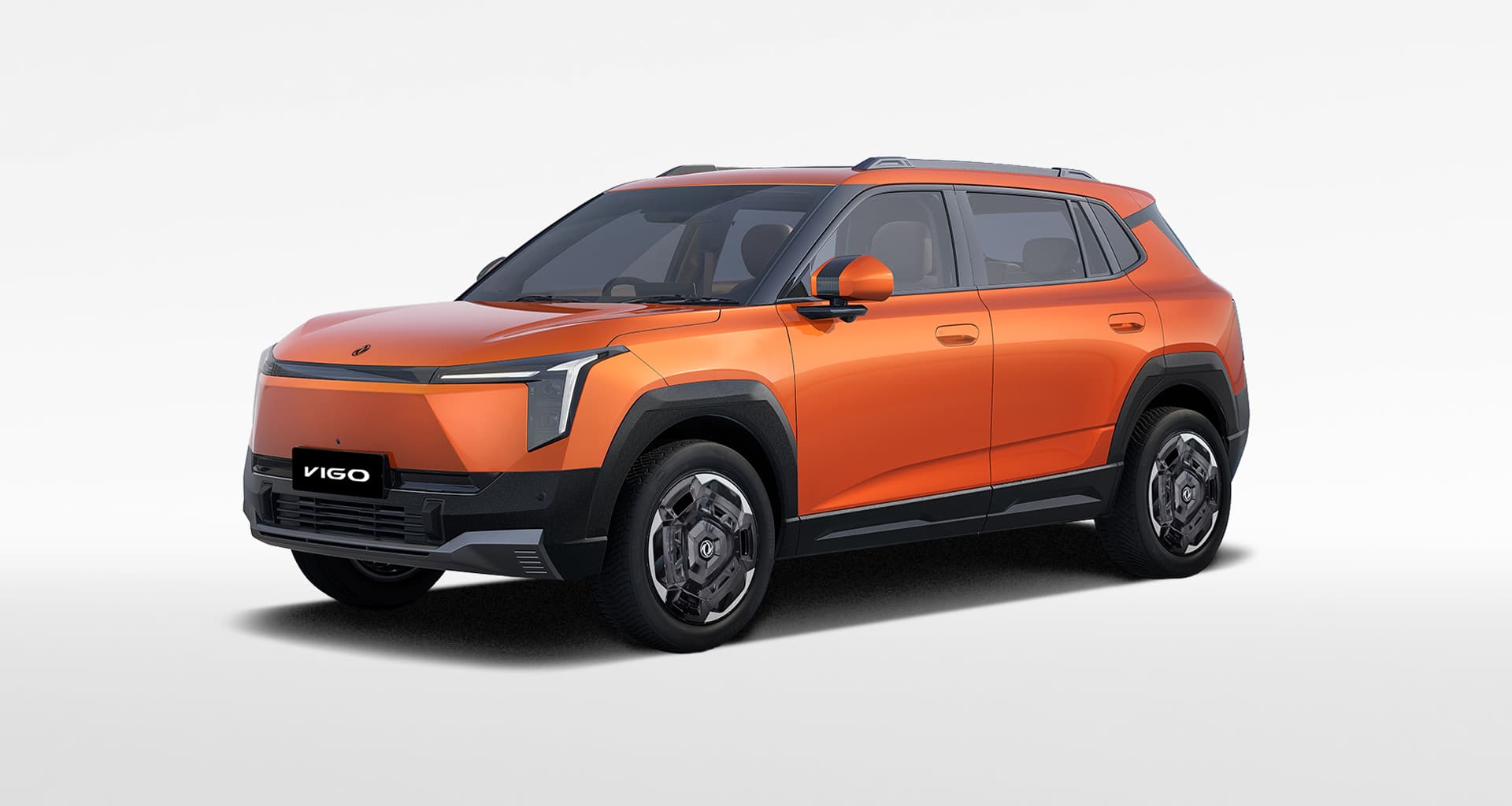 Regional vehicle shown. Local specification may differ.
THE DETAILS THAT MAKE VIGO DIFFERENT
Eight standout details from the GIRACH VIGO brochure. Explore all 65 listed details below, including optional and market-specific equipment.
Open up.
Open the upper section independently; use the lower section as a loading platform. Confirm its load rating before sitting on it.
Brochure pp. 7, 8500 L + 72 L
A flat 500 L luggage area and a separate 72 L concealed compartment help organise larger bags and smaller belongings.
Brochure p. 242,000 mm
The brochure illustrates a two-metre folded-seat bed arrangement. Use the rest configuration only while safely parked.
Brochure p. 8Heat pump
Heat-pump A/C and direct battery cooling are described in the brochure. Confirm the specification supplied locally.
Brochure pp. 10, 2950 W / 60 W
A 50 W wireless pad and 60 W USB-C port are listed. Charging performance depends on device compatibility and fitted equipment.
Brochure pp. 14, 15128 colours
The door lighting offers a choice of 128 colours, adding a distinctive visual detail to the cabin.
Brochure p. 143.3 kW V2L
The brochure describes external power for compatible appliances. Use approved adapters and follow the operating instructions.
Brochure p. 31540° view
Four surround cameras support bird’s-eye and transparent-chassis views. Imaging assists, but never replaces, careful observation.
Brochure p. 41Brochure equipment is not a confirmation of local stock or standard specification. Confirm the delivered vehicle, accessories and operation with GIRACH.
Explore all 65 brochure details01 / EXTERIOR
Distinctive T-shaped daytime running lamps, a strong, upright profile and a two-section tailgate give the VIGO its own unmistakable character.
02 / INTERIOR
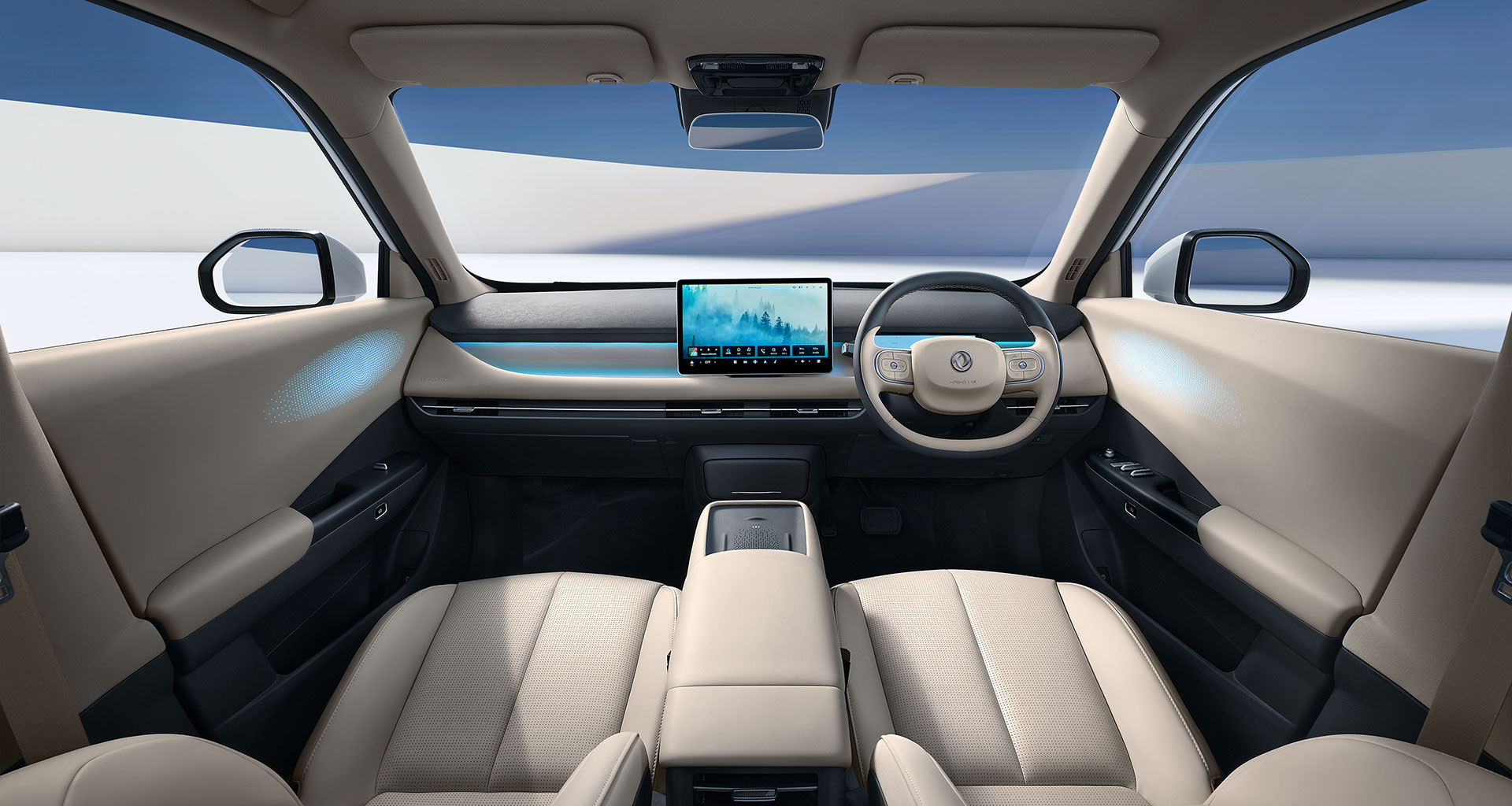
A clean, open centre console, soft-touch surfaces and a considered digital cockpit. Every journey starts with a little more breathing room.
03 / STYLE CHOICES
Explore original Dongfeng regional colour images. The local brochure names and regional image names are shown separately. Confirm your exact paint choice with GIRACH.
Sunset Orange
Regional image: Future Orange · Dongfeng New Zealand
Local names: GIRACH brochure p. 19. Images: Dongfeng New Zealand. Regional names are shown separately; matching Malawi paint codes are not verified. Confirm finish, wheels and availability with GIRACH.
04 / SPACE
The two-section tailgate opens up a different way to load, relax and make the most of a stop. Inside, flexible seating and layered storage help the VIGO adapt to the day.
A flat loading area, with a separate 72 L hidden storage compartment described in the brochure.
Pages 7 and 8 differ on the lower section’s 150 kg load reference. Confirm its rating before use. Follow the vehicle’s operating instructions.
The brochure describes a 2,000 mm bed arrangement with the rear seating folded. Use only while parked.
05 / PERFORMANCE
30–80% DC charging reference
The product-parameter table gives an 18-minute 30–80% charging reference. Actual time depends on the battery, charger output, temperature and vehicle specification.
Understand electric ownership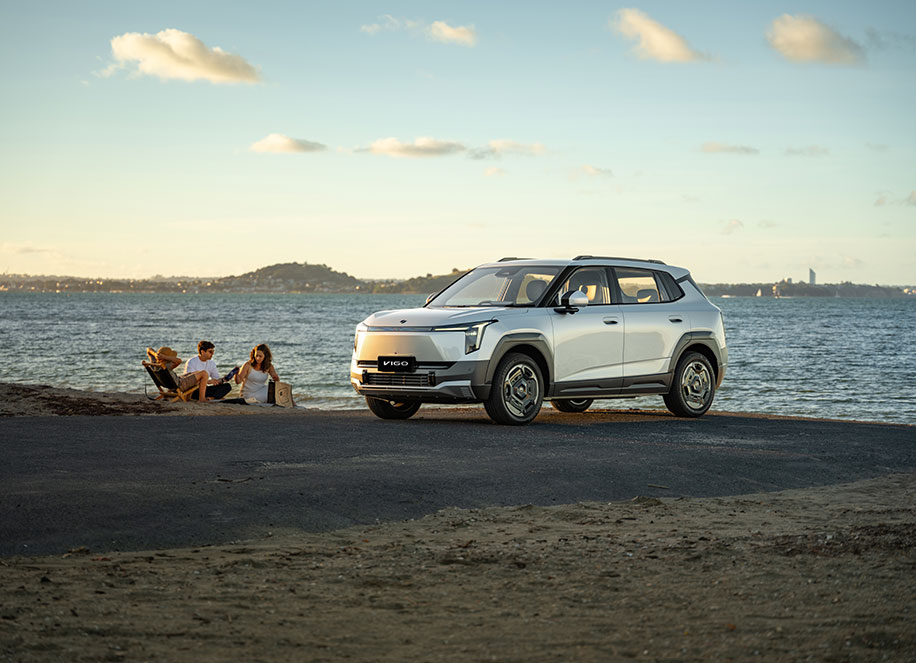 ELECTRIC. INTELLIGENT. FUTURISTIC.
06 / TECHNOLOGY
Discover the features described in the VIGO brochure, then confirm the equipment that comes with your Malawi vehicle.
The brochure lists CarPlay, Bluetooth and voice recognition alongside the 12.8-inch central screen. Confirm local connected services.
A 540° panoramic imaging function is described in the brochure to help show the surroundings and the area beneath the vehicle.
Adaptive cruise control, collision warning and lane-assistance functions are listed. Equipment is market- and trim-dependent. Driver attention remains essential.
The brochure lists a 3.3 kW external-discharge function for suitable devices, using approved vehicle-to-load equipment.
Technology and outdoor applications · brochure pp. 31, 38–42. Confirm the exact Malawi trim and supplied accessories before ordering.
EXPLORE EVERY DETAIL
The supplied GIRACH brochure, chapter by chapter. Optional equipment, market-specific functions and conflicting source figures are identified here, not assumed to be local standard equipment.
65 features
An upright front profile, an enclosed grille design and a geometric silhouette define the VIGO exterior.
T-shaped daytime running lamps and the illustrated rear-light signature distinguish the front and rear views.
Electric folding rear-view mirrors with a heating function are listed.
R18 aluminium-alloy wheels are identified for E2+ versions. Wheel design and specification are trim-dependent.
The upper section can open independently in height-restricted spaces. The lower section provides a loading or temporary seating platform.
Page 7 states a maximum 150 kg load; page 8 describes over 150 kg. Confirm the delivered vehicle rating and operating instructions before loading or sitting on it.
A passage between the screen and console creates an open cabin layout, with low-level storage for a handbag and daily items.
Two remote-control keys and one mechanical key, keyless entry, auto-locking while driving and collision-triggered unlocking are listed on page 10.
Heat-pump A/C is described as standard in the interior list. The performance chapter also describes direct battery cooling.
Sun visors with soft-light vanity mirrors are listed for the driver and front passenger.
The seating chapter describes supportive, ergonomically shaped breathable seats. The front seat is illustrated reclining to 175°; reclining is for parked use.
Heating, ventilation, massage and six-way electric adjustment are listed with E2+, export-market and premium-version qualifications. The courtesy function is illustrated separately.
The brochure limits steering-wheel heating to specified CIS and premium European versions; it is not a confirmed Malawi feature.
Steering-wheel controls are illustrated for everyday access to vehicle functions.
Ripple-pattern ambient lighting is illustrated on the doors with 128 colour choices.
The brochure lists a 50 W wireless phone charging pad. Compatible-device requirements and the fitted trim need confirmation.
A 60 W fast-charging Type-C interface is listed alongside the wireless charging pad.
A concealed glasses case, pull-out cup holders and a lower storage area are shown around the console.
A sculpted recessed platform ahead of the front passenger is designed for small items.
Sunset Orange, Mist Green, Wheat Yellow, Stone White, Phantom Silver and Midnight Black are the local brochure names. Regional source-image names are identified separately.
Beige/Black (light gray) and Gray/Black (dark gray) combinations are illustrated. Final interior availability depends on the local vehicle.
The parameter table and space chapter state 2,715 mm; page 2 states 2,700 mm. The page 3 value is retained here without concealing the difference.
The space chapter highlights short front and rear overhangs and a 67% space-utilisation reference. This is a brochure metric, not a measured cabin-volume figure.
A 48 L layered front compartment is described for upper/lower and wet/dry item separation. Page 23 identifies it as an after-sales accessory, not included standard equipment.
The brochure describes a flat, layered 500 L rear luggage area for larger items and everyday storage.
A rear partition creates a separate 72 L concealed compartment beneath the main luggage area.
The brochure describes a 2,000 mm bed arrangement using the folded seats. This is an illustration for stationary use, not seating while driving.
A panoramic sunroof is shown for daytime and night-sky viewing and is explicitly described as optional.
The brochure lists 8.8 m² of sound-absorbing material and insulation in 37 positions. It also describes a three-horizontal/two-vertical body connection arrangement.
Page 26 states electric-drive peak noise of ≤18 dB but does not provide a complete test protocol. It is not represented here as cabin noise during normal driving.
The product table identifies a Mach E electric-drive assembly, maximum power of 120 kW and maximum torque of 230 N·m.
Page 3 lists 44.94 kWh / 401 km CLTC and 51.87 kWh / 471 km CLTC versions. The cover features the 51.87 kWh version. Real-world results vary.
The parameter table states an 18-minute reference. Page 36 instead states 16 minutes. Charging time depends on vehicle, charger and conditions.
Page 28 describes 3C fast charging, 154 kW peak power and 114 km of added range in five minutes. Pages 2 and 31 refer to 167 kW. These claims are not a confirmed local charging curve.
The outdoor-support chapter identifies 6.6 kW AC charging as standard and 11 kW as version-dependent optional equipment. Confirm the locally supplied charging port.
A 3.3 kW vehicle-to-load function is described for suitable external electrical appliances. Use approved equipment and confirm the supplied adapter.
Page 2 gives an operating-temperature range of −30°C to 50°C. This is a brochure reference, not a guarantee of unchanged range or charging at those temperatures.
The brochure claims 45% lower energy consumption and 21% greater low-temperature range versus traditional PTC A/C, with refrigerant/liquid temperature control and direct battery cooling. Test conditions are not fully supplied.
Shopping, personalised modification, trunk markets, cargo transport, night camping and hobby activities are illustrated as six application scenarios.
The brochure describes a one-touch rest mode with coordinated seat, air-conditioning, lighting and screen behaviour. Use only while safely parked.
An outdoor camp mode and vehicle-to-load applications are illustrated for stationary leisure use.
An external-play mode is described with an outside speaker linked to the in-car music. Confirm local equipment and use it considerately.
The brochure describes retained power and temperature control while the vehicle is parked and locked. This must not be treated as permission to leave children or animals unattended.
Electronic door release is described with a separate emergency mechanical button.
Approach-based keyless unlocking and adaptation to personalised scenarios are described.
The brochure states 68.4% high-strength steel for the non-sunroof structure and 1,500 MPa hot-formed steel in the A-, B- and C-pillars, with four force-transmission designs.
Page 34 gives a 67% galvanising ratio and 100% galvanisation of exposed parts. It illustrates a three-way structure, double-cavity tailgate ring, anti-collision beam and ring-shaped front compartment framework.
An aluminium-alloy battery enclosure with an IPX9K rating is described. The brochure refers to three times the compression-test count and twice the vibration-test count versus cited national requirements; no independent test report is supplied.
Page 36 identifies LFP battery cells, thermal management and 24-hour thermal-runaway monitoring.
Page 36 describes nail-penetration and external-fire tests, a zero-thermal-diffusion claim and an escape-time comparison. Those are brochure test claims, not guarantees of immunity to battery fire.
The brochure describes CTP packaging, a ten-in-one electric drive and ≥75% battery state of health after more than 2,500 cycles. Its eight-year/300,000 km service-life reference is not the cover warranty.
Page 36 gives 43.3/51.5 kWh, unlike the 44.94/51.87 kWh parameter table. Confirm the supplied battery version before ordering.
A 12.8-inch, 16:9 screen is listed. Page 39 gives 1920 × 1080 pixels, a ≤20 ms response reference and a thickness below 15 mm.
Pages 11 and 38 state 8.88 inches; page 39 rounds this to 8.8 inches and describes a 4:1, 1920 × 471 display with a ≥60 fps frame rate and ≥800 cd/m² luminance.
The entertainment chapter identifies a Qualcomm 6125 chip for the intelligent cabin.
CarPlay, FM/AM radio, Bluetooth audio and Bluetooth phone functions are listed in the entertainment chapter.
The brochure lists voice commands for multimedia, phone, air conditioning and windows.
ECO and Sport modes are named alongside the intelligent scene functions.
Internet service, over-the-air upgrades and DAB are described as dependent on the vehicle region or country. Do not assume local service compatibility.
The IVI chapter illustrates navigation, an offline state, 3D landmarks and conveniently arranged steering-wheel controls. Map and software availability are market-dependent.
The brochure describes four surround wide-angle cameras, bird’s-eye and transparent-chassis views, obstacle/road-condition awareness and activation linked to steering and speed.
Autonomous emergency braking descriptions cover pedestrians, two-wheelers and four-wheelers. Front collision warning is also listed. These assist an attentive driver and do not replace one.
Lane-departure warning and lane-keeping assist are listed.
Traffic-sign recognition and intelligent speed control are listed.
ACC and ICA are listed, with ICA described as switching between Traffic Jam Assistance and Highway Driving Assistance according to speed.
No matching features. Try a different word or select all chapters.
07 / SPECIFICATIONS
Figures and equipment below are transcribed from the supplied GIRACH product brochure. They are not a confirmed local stock or equipment list.
| Specification | Brochure information | Source |
|---|---|---|
| Powertrain | Battery electric vehicle (BEV) | p. 3 |
| Maximum motor power | 120 kW | p. 3 |
| Maximum torque | 230 N·m | p. 3 |
| Battery capacity, featured version | 51.87 kWh | pp. 1, 3 |
| Alternative battery in brochure | 44.94 kWh | p. 3 |
| Featured range | Up to 471 km, CLTC | p. 3 |
| Alternative range in brochure | 401 km, CLTC | p. 3 |
| DC charging reference | 30–80% in 18 minutes¹ | p. 3 |
| AC charging in brochure | 6.6 kW; 11 kW optional depending on version | p. 31 |
| Specification | Brochure information | Source |
|---|---|---|
| Length × width × height | 4,306 × 1,868 × 1,654 mm | p. 3 |
| Wheelbase, parameter table | 2,715 mm³ | pp. 3, 22 |
| Luggage space | 500 L | p. 24 |
| Hidden rear storage | 72 L | p. 24 |
| Two-section tailgate | Lower section rated over 150 kg in brochure | p. 8 |
| Specification | Brochure information | Source |
|---|---|---|
| Central screen | 12.8 inches | pp. 11, 38 |
| Instrument display | 8.88 inches (rounded to 8.8 elsewhere)³ | pp. 11, 38–39 |
| Interior choices | Beige/Black; Gray/Black | p. 20 |
| Ambient lighting | 128-colour ripple lighting² | p. 14 |
| Panoramic sunroof | Optional | p. 25 |
| Panoramic imaging | 540° function² | p. 41 |
| Wireless phone charging | 50 W² | p. 15 |
¹ Range and charging figures are brochure references, not guaranteed real-world results. The 471 km figure is CLTC and corresponds to the 51.87 kWh version. Charging depends on compatible equipment, battery state and conditions.
² Features, driver assistance, connected services, colours and accessories depend on version and market. Brochure imagery includes overseas vehicles; steering position and equipment may differ from the delivered Malawi vehicle.
³ The brochure contains inconsistent wheelbase, instrument-size, battery-capacity, charging-time and peak charging-power references. Page 36 states 16 minutes rather than the parameter table’s 18 minutes and lists different battery capacities. See the complete feature library for page-specific notes. The page 3 parameter-table wheelbase is shown here, with the discrepancy retained for confirmation. No definitive peak DC charging-power claim is published.
EXPERIENCE ELECTRIC · BLANTYRE